
MSc in Nursing in UK 2026
Table of Contents
- Top Universities Offering MSc in Nursing in UK
- Why choose for MSc in Nursing in UK
- MSc in Nursing in UK Eligibility and Admission Requirements
- Year-wise Curriculum for MSc in Nursing in UK
- Tuition Fees and Duration of MSc in Nursing in UK
- Cost of Living for MSc in Nursing in UK
- How to Apply for MSc in Nursing in UK
- Are Scholarships available for an MSc in Nursing in UK
- Career Opportunities after MSc in Nursing in UK
- Author's Thoughts
Pursuing an MSc in Nursing in UK in 2026 offers an exceptional opportunity for ambitious Indian students looking to elevate their global healthcare careers. This 1-to-2-year advanced postgraduate program caters perfectly to both experienced nurses upgrading clinical skills and graduates seeking a pre-registration route to become Registered Nurses. For international applicants, annual tuition fees typically range from £17,000 (₹21,44,040) to £47,700 (₹6,015,924). To secure admission and register with the Nursing and Midwifery Council (NMC), Indian students must achieve an IELTS score of 6.5 to 7.0 (or OET equivalent), unlocking world-class training and premier global employment options.
Here is a quick overview of the essential highlights for an MSc in Nursing in UK.
Key Feature | Program Details |
Duration | 1 to 2 Years |
Average Tuition Fee | £17,000 - £31,000 (INR 21,67,160 - 39,51,880) |
Starting Salary | £32,500 - £73,000 (INR 41,43,100 - 93,06,040) |
English Requirement | IELTS (6.5+) or PTE (60+) |
Intake Season | September/January 2026 |
Post-Study Work | 2-Year Graduate Route Visa |
Clinical Exposure | Included in Curriculum |
Top Universities Offering MSc in Nursing in UK
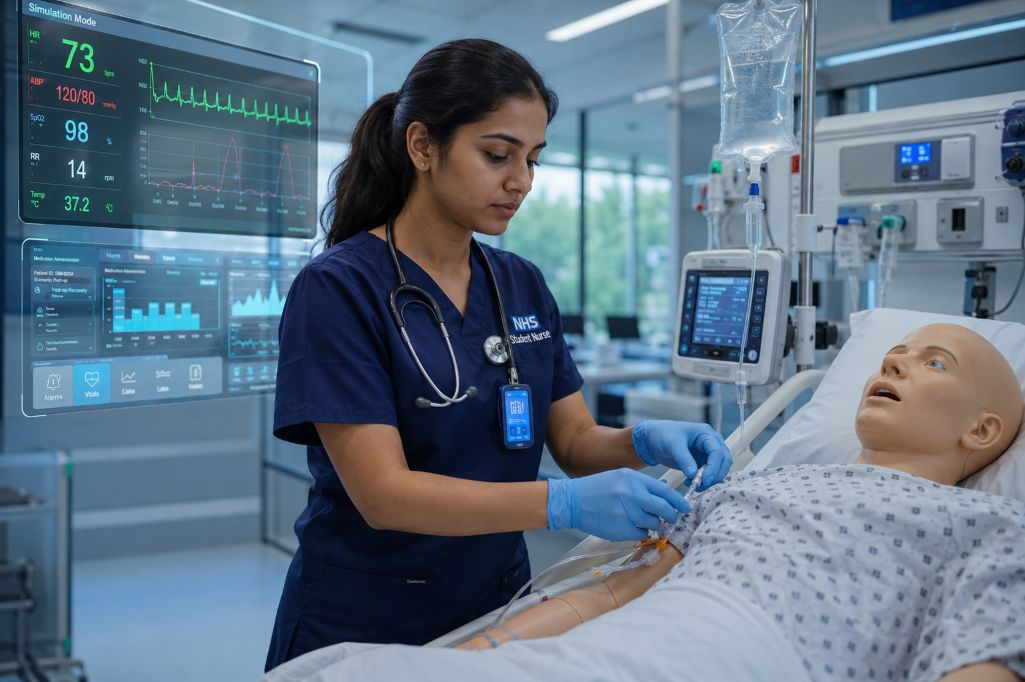
UK is home to some of the world's most prestigious nursing schools, combining rigorous academics with extensive clinical training. These top-tier institutions provide exceptional research frameworks, state-of-the-art simulation labs, and great career support systems for international postgraduate students.
This table provides a comprehensive overview of the top UK universities for nursing, showcasing their 2026 global rankings and annual tuition fees.
University Name | 2027 QS World Rankings | Tuition Fee (£) / Tuition Fee (INR) |
King's College London | #37 | £29,472 (INR 37,57,090) |
The University of Manchester | #40 | £25,000 (INR 31,87,000) |
University of Southampton | #111 | £26,100 (INR 33,27,228) |
The University of Edinburgh | #35 | £28,800 (INR 36,71,424) |
Queen's University Belfast | #174 | £26,000 (INR 33,14,480) |
University of Birmingham | #68 | £25,000 (INR 31,87,000) |
University of Glasgow | #80 | £28,260 (INR 36,02,585) |
University of Leeds | #77 | £26,000 (INR 33,14,480) |
University of Liverpool | #139 | £26,400 (INR 33,65,472) |
University of Nottingham | #97 | £28,600 (INR 36,45,928) |
Why choose for MSc in Nursing in UK
Studying in UK gives nursing professionals an incredible advantage due to advanced medical facilities and strong global recognition. The program builds foundational leadership skills, ensures high starting salaries, and provides direct clinical engagement with global healthcare networks to elevate your career.
This table highlights the major benefits and strategic advantages of obtaining your master's degree in nursing in UK.
Benefit Area | Strategic Advantage for Students |
High Employability | 94.2% of nursing graduates secure relevant employment quickly. |
Job Market Demand | UK health sector faces a shortage of specialized clinical leaders. |
Global Recognition | UK degrees hold international value, boosting worldwide career prospects. |
Research Focus | Strong focus on clinical research valued by healthcare systems globally. |
Practical Exposure | Access to state-of-the-art simulation labs and real-world clinical placements. |
Post-Study Visa | Two-year post-study work visa allows for career stabilization. |
Global Rank | UK holds the #2 global rank for producing top nursing graduates in 2026. |
MSc in Nursing in UK Eligibility and Admission Requirements
Securing admission into a top UK nursing program requires meeting strict academic and professional standards. The process evaluates your educational background, practical experience, and language proficiency to ensure you are fully prepared for rigorous clinical coursework and healthcare leadership roles.
This table outlines the specific eligibility criteria Indian students need to fulfill for a successful university application.
Requirement Category | Specific Eligibility Details |
Academic Base | Bachelor's degree in nursing (BSc) with a minimum of 60%. |
Professional Registration | Active registration as a nurse with the State Nursing Council or INC. |
Work Experience | 1-2 years of clinical work experience is highly preferred. |
Language Proof | IELTS score of 6.5+ or PTE score of 60+. |
Statement of Purpose | A personalized statement detailing your professional and clinical career goals. |
Letters of Recommendation | Two strong professional or academic references from mentors. |
Financial Proof | Evidence of funds to cover tuition fees and basic living costs. |
Year-wise Curriculum for MSc in Nursing in UK
UK master's programs in nursing are meticulously designed, merging advanced theoretical concepts with practical clinical applications. Depending on the university, the curriculum spans one to two years and focuses heavily on leadership, patient care, evidence-based practices, and intensive research methodologies.
Year 1 Curriculum
The first year establishes the essential advanced clinical foundations and research methodologies required for healthcare leadership.
The table below breaks down the core modules generally covered during the first year of the program.
Module | Core Learning Objectives |
Advanced Clinical Practice | Developing high-level assessment and diagnostic skills. |
Evidence-Based Practice | Applying current research to improve patient care outcomes. |
Healthcare Leadership | Managing nursing teams and navigating hospital administration. |
Pathophysiology | Understanding disease processes for better clinical decisions. |
Public Health Nursing | Promoting health and preventing diseases in communities. |
Year 2 Curriculum
The second-year transitions into advanced specialized electives, independent dissertations, and intensive hands-on healthcare placements.
The table below highlights the advanced topics and hands-on components typical of the second year.
Module | Core Learning Objectives |
Specialist Elective | Focused study on areas like mental health, pediatrics, or oncology. |
Clinical Placements | Direct patient care under supervision in NHS or private settings. |
Research Dissertation | Conducting an original research project on a nursing topic. |
Advanced Pharmacology | Principles of prescribing and medication management. |
Quality Improvement | Designing initiatives to enhance patient safety and care quality. |
Tuition Fees and Duration of MSc in Nursing in UK
Understanding the financial commitment is crucial before applying to your preferred university. Tuition fees vary widely based on the institution's ranking and location, but the typical duration remains compressed to maximize your early return on investment and enter the workforce faster.
This table compares the tuition costs for all the top universities listed.
University | Tuition Fee (£) | Tuition Fee (INR) |
King's College London | £29,472 | INR 37,57,090 |
The University of Manchester | £25,000 | INR 31,87,000 |
University of Southampton | £26,100 | INR 33,27,228 |
The University of Edinburgh | £28,800 | INR 36,71,424 |
Queen's University Belfast | £26,000 | INR 33,14,480 |
University of Birmingham | £25,000 | INR 31,87,000 |
University of Glasgow | £28,260 | INR 36,02,585 |
University of Leeds | £26,000 | INR 33,14,480 |
University of Liverpool | £26,400 | INR 33,65,472 |
University of Nottingham | £28,600 | INR 36,45,928 |
Cost of Living for MSc in Nursing in UK
The overall living costs will heavily depend on whether you choose to reside in central London or regional cities.
The following table breaks down estimated monthly living expenses for an international student.
Living Factor | Estimated Monthly Cost (£) | Monthly Cost (INR) |
Rent (Inner City) | £600 | INR 76,488 |
Utilities (Gas/Elec) | £185 | INR 23,583 |
Internet/Phone | £45 | INR 5,736 |
Local Transport | £65 | INR 8,286 |
Personal Allowance | £125 | INR 15,935 |
Source: Numbeo
Funds needed every year for transportation, groceries, accommodation and other essentials
Proper annual budgeting ensures you remain financially stable throughout your academic tenure in the United Kingdom.
This table provides a realistic annual breakdown of major essential expenses during your academic year.
Annual Expense | Estimated Yearly Cost (£) | Yearly Cost (INR) |
Accommodation | £7,200 | INR 9,17,856 |
Groceries / Meals | £2,400 | INR 3,05,952 |
Transportation | £780 | INR 99,434 |
Utilities | £2,220 | INR 2,82,987 |
Personal Expenses | £1,500 | INR 1,91,220 |
How to Apply for MSc in Nursing in UK
The application process requires systematic planning to ensure all academic and professional credentials are valid. Deadlines for the primary intakes close months in advance, making early submission highly recommended for competitive nursing seats across the top universities in the country.
This table outlines key steps and strategic tips to streamline your university application process.
Application Step | Strategic Pointer for Success | Important Timeline |
Course Selection | Match university specializations with your long-term clinical interests. | 8-10 Months Before Intake |
Document Gathering | Ensure your home country nursing registration is translated and verified. | 6-8 Months Before Intake |
Language Testing | Book and complete your IELTS/PTE early to avoid delays. | 6 Months Before Intake |
SOP Writing | Highlight your clinical experience and passion for patient care. | 4-5 Months Before Intake |
Portal Submission | Review your complete application for accuracy before submitting. | 3-4 Months Before Intake |
Interview Prep | Practice responding to clinical scenario-based and behavioral questions. | 2-3 Months Before Intake |
Visa Application | Apply for a UK Student Visa immediately after receiving your CAS letter. | 2 Months Before Intake |
Are Scholarships available for an MSc in Nursing in UK
Pursuing higher education abroad is a major financial decision, but UK provides several prominent scholarships for international students. These grants are predominantly merit-based, helping drastically reduce the overall tuition burden for deserving candidates looking to advance their clinical careers globally.
This table lists notable scholarships available to nursing students, including their respective funding values.
Scholarship Name | Value in GBP (£) | Value in INR (approx) |
King's International Scholarship | £25,000 | INR 31,87,000 |
Chevening Scholarship | Fully Funded (Tuition + Stipend) | Varies based on tuition |
Commonwealth Master's Scholarship | Tuition + £1,452/month | Tuition + INR 1,85,101/month |
GREAT Scholarship | Minimum £10,000 | Minimum INR 12,74,800 |
University of Glasgow Leadership Award | £10,000 | INR 12,74,800 |
Global Excellence Scholarship | £6,000 | INR 7,64,880 |
Ulster Postgraduate Scholarship | £2,000 | INR 2,54,960 |
Career Opportunities after MSc in Nursing in UK
Graduates with an advanced nursing degree are in exceptionally high demand across UK's healthcare networks. The blend of specialized clinical skills and operational management training allows you to comfortably secure competitive roles, leading to excellent salary progressions and long-term professional stability globally.
This table details the diverse job roles you can pursue, along with the competitive salary ranges available in UK.
Job Role | Salary Range (£) | Salary Range (INR) |
Clinical Nurse Specialist | £35,000 - £50,000 | INR 44,61,800 - 63,74,000 |
Advanced Nurse Practitioner | £45,000 - £65,000 | INR 57,36,600 - 82,86,200 |
Nurse Manager | £40,000 - £60,000 | INR 50,99,200 - 76,48,800 |
Nurse Educator | £38,000 - £55,000 | INR 48,44,240 - 70,11,400 |
Nurse Researcher | £32,000 - £45,000 | INR 40,79,360 - 57,36,600 |
Public Health Nurse | £34,000 - £47,000 | INR 43,34,320 - 59,91,560 |
Mental Health Practitioner | £36,000 - £52,000 | INR 45,89,280 - 66,28,960 |
Source: Glassdoor
Top 5 Employers for Job Opportunities
The following major healthcare institutions frequently hire specialized nursing graduates for advanced clinical roles.
This table showcases the top employers in UK healthcare market, their primary sector focus, and core hiring areas.
Employer Name | Sector Focus | Key Hiring Area |
National Health Service (NHS) | Public Healthcare | Emergency, ICU, Ward Management |
Bupa UK | Private Healthcare | Care Homes, Specialist Clinical Care |
Nuffield Health | Private Hospital & Wellness | Surgical Units, Outpatient Care |
Spire Healthcare | Private Hospitals | Acute Care, Diagnostic Nursing |
Care UK | Residential Social Care | Residential Care, Mental Health |
Source: Glassdoor
Author's Thoughts
Earning an MSc in Nursing in UK in 2026 is an outstanding pathway to advance your clinical career on a global scale. With state-of-the-art training facilities, high employability, and the chance to work within esteemed institutions like the NHS, this degree provides a remarkable return on investment. As the demand for specialized nurses grows, your advanced skills will make you a vital asset to any healthcare system, especially in UK.
Ready to embark on your masters journey in Nursing in UK? Connect with our experts to know about concerned universities, courses, scholarships, admissions, and career opportunities.